
When it comes to building, remodeling, or improving the energy efficiency of a home or building, choosing the right insulation makes a big difference! One product that has become a popular choice is XPS insulation (also known as extruded polystyrene insulation).
So What Is It?
It is a rigid foam board insulation sheet, usually in 4×8 dimensions, that is designed to provided maximum thermal performance, moisture resistance, and durability. Whether you are insulating a basement, building a garage, pouring a concrete slab, or working on a new project, XPS has a variety of uses.
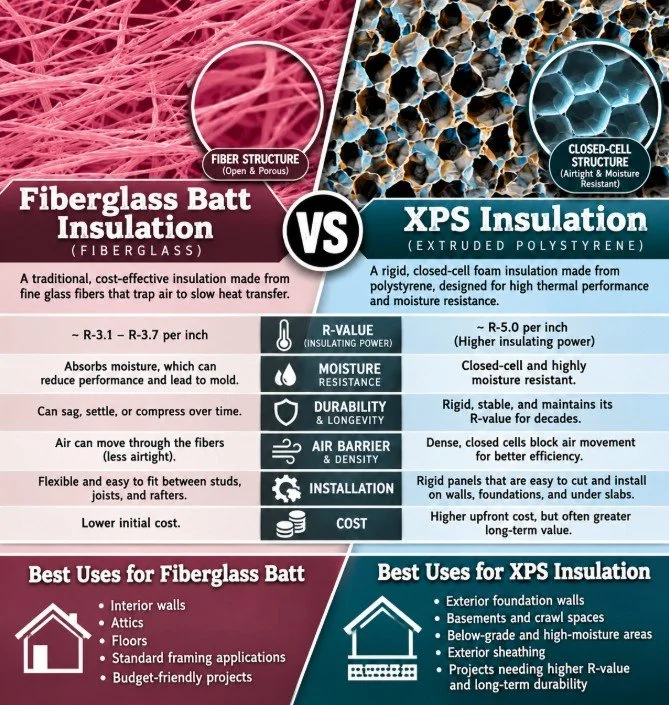
It has what is called a closed-cell structure. You may recognize it by its familiar colored foam boards, which are commonly pink, blue, green or gray depending on the exact manufacturer. This is a solid, lightweight board that provides insulation throughout the entire panel instead of it being comprised of loose fibers. It helps resist water absorption unlike the loose fibers of standard fiberglass batt insulation. While there are many great applications for standard fiberglass batt insulation that should be utilized, it is best to make the right decision based on the application needs.
How is It Made?
XPS insulation is manufactured using a process called extrusion. It starts as a polystyrene resin that is combined with additives and a blowing agent. —> The materials are then all heated and melted into a uniform mixture. —>The mixture is then pushed through specialized equipment under controlled heat and pressure. —>As the material exits the extrusion equipment, the pressure changes and the blowing agent helps create tiny, closed cells throughout the foam. —> The continuous foam board is then cooled, stabilized, and cut into sheets of specific thicknesses and sizes.
The Benefits
Excellent Insulating Value: XPS provides approximately an insulation factor of 5 per inch. This means you can achieve substation insulation value without taking up as much space as other materials may require.
Moisture Resistance: One of its biggest advantages is its resistance to moisture absorption. Its closed-cell structure makes it useful in areas damp conditions exist like basements, foundations, and concrete slabs.
Strength and Durability: XPS is manufactured in different compressive strength ratings which makes it suitable for withstanding weight and pressure, usually under concrete slabs.
Lightweight and Easy to Install: The rigid boards are easy to transport, handle, score, and cut.
Long Term Performance: When properly selected and installed, XPS can provide long-lasting thermal performance in demanding building applications.
A Few Things to Keep In Mind
While XPS has many advantages, proper instillation is important.
Make sure you choose the correct thickness and compressive-strength rating for your application.
Use adhesives specifically approved for your project and the XPS sheets.
Follow local building codes and installation instructions.
It should not be left exposed unless the specific application is approved.
Always find it at the best price! Purchasing out of the normal season is a great way to find a decent price on it.